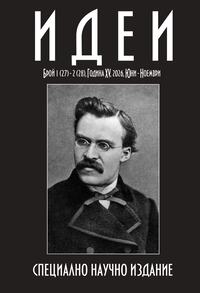
The Ethical and the Moral in the Teaching of Friedrich Nietzsche (part one)
Abstract
At the beginning of the twenty-first century, humanity faces serious challenges that threaten its very existence. Among these is the intensification of geopolitical tensions between powerful states with fundamentally opposing systems of governance. On the one hand, there are established democracies characterized by advanced scientific achievements and technological development; on the other, states that have access to such achievements but are governed by rigidly authoritarian regimes. These opposing models are grounded in distinct philosophical, religious, political, and legal traditions, which have shaped enduring patterns of behavior that are difficult, if not impossible, to overcome. In such conditions, especially during periods of crisis, relations between states tend to be governed not by the rule of international law but by the law of force. This tendency is particularly dangerous, as it increases the likelihood that military power—rather than rational argument – will determine outcomes, posing a threat not only to humanity but also to the natural environment. Against this background, the philosophical reflections of Friedrich Nietzsche on the Übermensch (Superhuman) and his supposed right to determine human destinies from positions that challenge established moral norms retain their relevance. In modern democratic societies, these norms have been transformed into ethical and legal standards with the status of international law. Given that Nietzsche’s ideas were widely appropriated for anti-human purposes during the two world wars, there is a pressing need to reconsider and critically reassess his legacy. Such a reassessment may be guided by the didactic principle that rereading leads to deeper understanding: not only does the reader interpret the text, but the text also “interprets” the reader. In this regard, particular attention should be paid to Nietzsche’s work The Will to Power as a key source for re-evaluating the ethical and moral dimensions of his philosophy.
References
Bacon, F. (2000), The New Organon, Cambridge University Press, New York, 252 p.
Bern, E. (2022), Introduction to psychiatry and psychoanalysis. Just about the complex [Vstup do psy`xiatriyi ta psy`xoanalizu. Prosto pro skladne] [trans. from English. O. Oksenych], KSD, Kharkiv, 416 p. [in Ukrainian].
Bible [Bibliya] (1994), Ukrainian Bible Society, Kyiv, 1255 p. [in Ukrainian].
Comenius, J. A. (1982), Selected pedagogical works: in 2 vols. [Vy`brani pedagogichni tvory`: v 2-x t.], Higher school, Kyiv, 656 p. [in Ukrainian].
Dontsov, D. (1991), Spirit of our antiquity [Dux nashoyi davny`ny`], Renaissance, Drohobych, 342 p. [in Ukrainian].
Fromm, E. (2010), To Have or to Be? [Maty` chy` buty`?] [trans. from English by A. Buryak, O. Mykhaylova], Ukr. writer, Kyiv, 222 p. [in Ukrainian].
Hegel, G. V. F. (2023), Science of logic. Encyclopedia of philosophical sciences. Minor logic: tutorial [Nauka logiky`. Ency`klopediya filosofs`ky`j nauk. Mala logika: navch. posib.]. Compiled by B.O. Lys, Lyra-K Publishing House, Kyiv, 372 p. [in Ukrainian].
Heidegger, M. (2003), Was ist das - die Philosophie?, Klett-Cotta ca., Stuttgart, 2003., 30 s.
Latin-Ukrainian Word-Formation Dictionary [Laty`ns`ko-ukrayins`ky`j slovotvirny`j slovny`k] (2010), Textbook – Bohdan, Ternopil, 880 p. [in Ukrainian].
Lorenz, K. (1974), On Aggression, Routledge, London and New York, xiv, 306 p.
Montaigne, M. (2006), Experiments. Book II [Proby`. Kny`ga II] [trans. from French by A. Perepadya], Spirit and Letter, Kyiv, 515 p. [in Ukrainian].
Nietzsche, F. (1993), Thus Spoke Zarathustra. The Lust for Power [Tak kazav Zaratustra. Zhadannya vlady`], Foundations, Kyiv, 415 p. [in Ukrainian].
Ortega-y-Gaset, H. (1994), “The Revolt of the Masses” [“Bunt mas”], Selected Works, Foundations, Kyiv, pp.15-139 [in Ukrainian].
Smith, J., E. (1994), National Identity [Nacional`na identy`chnist`], Foundations, Kyiv, 223 p. [in Ukrainian].
Toynbee, A. (1995), Studies in History: in 2 vols. [Doslidzhennya istoriyi: u 2-x t.], Foundations, Kyiv, Vol. 1, 614 p. [in Ukrainian].
Wojtyła, K. (1982), Elementarz etyczny, WKS, Wrocław, 139 s.